 |
| Figure 1 - Lycurgus Cup (left unlit/right lit from behind) http://thumbs.media.smithsonianmag.com//filer/phenomenon-Glow-With-Flow-631.jpg__800x600_q85_crop.jpg |
A more modern use of nanotechnology would be the use of silver nanoparticles which have an “anti-microbial” effect, used in socks and food bags. It’s surprising to know that my socks contain silver in them, and the fact that that silver is helping to stop bacteria and microbe growth in my sportswear. However, as Dr. Gimzewski notes in Nanotech Jim pt6, there are some dangers with using nanoparticles in everyday life. For example, he explains that “Slim Shake Chocolate”, a diet milkshake, uses “silica nanoparticles coated in cocoa clusters to increate taste”; after additional research I found out that nano-silica has the potential to cause pregnancy complications in mice, and thus “has raised health safety concerns, especially for pregnant woman”.
 |
| Figure 2 - Slim Shake Chocolate by Nanoceuticals http://corall-clubs.com/components/com_jshopping/files/img_products/full_819882.jpg |
Digressing from the lecture videos, I found something I learned in Physics 10 to be of some interest in the relation to Nanotechnology and Art. On the topic of atoms and molecular structure, we learned that scientists use a “scanning tunneling microscope” to measure atoms that measure “just a few nanometers in diameter”. The resulting image (as shown below) reminded me a lot of the “Brainbow” from last week’s lecture, and how science inadvertently can create such colorful pieces of art.
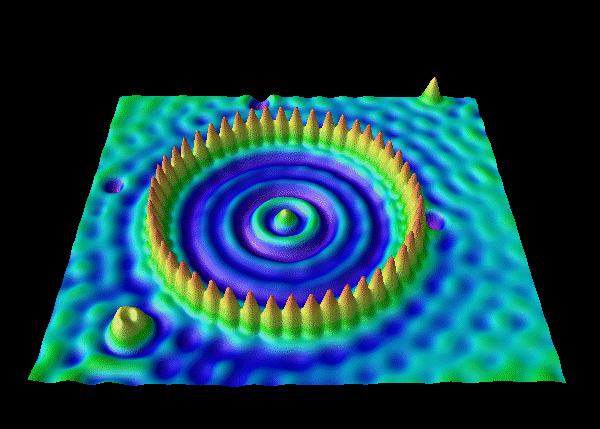 |
| Figure 3 - "Here they have positioned 48 iron atoms into a circular ring in order to "corral" some surface state electrons and force them into "quantum" states of the circular structure. The ripples in the ring of atoms are the density distribution of a particular set of quantum states of the corral." - IBM's "STM Image Gallery http://spiff.rit.edu/classes/phys314/lectures/stm/corral_top.gif |
Citations
- Jarreau, Paige Brown. "The Downside of Nano: Pregnancy Complications."SciLogscom. N.p., 07 June 2011. Web. 25 May 2015. <http://www.scilogs.com/from_the_lab_bench/the-downside-of-nano-pregnancy-complications/>.
- Merali, Zeeya. "This 1,600-Year-Old Goblet Shows That the Romans Were Nanotechnology Pioneers." Smithsonian Magazine. N.p., Sept. 2013. Web. 25 May 2015. <http://www.smithsonianmag.com/history/this-1600-year-old-goblet-shows-that-the-romans-were-nanotechnology-pioneers-787224/?no-ist>.
- Nanotech Jim Pt3. Perf. James Gimzewski. YouTube. YouTube, 21 May 2012. Web. 24 May 2015. <https://www.youtube.com/watch?t=472&v=X0HCNiU_108>.
- Nanotech Jim Pt6. Perf. James Gimzewski. YouTube. YouTube, 21 May 2012. Web. 24 May 2015. <https://www.youtube.com/watch?list=PL9DBF43664EAC8BC7&t=92&v=oKlViSKkPd0>.
- Richmond, Michael. "The Scanning Tunneling Electron Microscope." N.p., n.d. Web. 24 May 2015. <http://spiff.rit.edu/classes/phys314/lectures/stm/stm.html>.

No comments:
Post a Comment